Places · Richmond, British Columbia
Published
Finn Slough in Richmond: the history of a living fishing village
Finn Slough is a living waterside community near No. 4 Road and Dyke Road, not an abandoned attraction. Learn its Finnish fishing history and respect residents’ privacy.
Facts checked
In this story
The photograph leaves something out
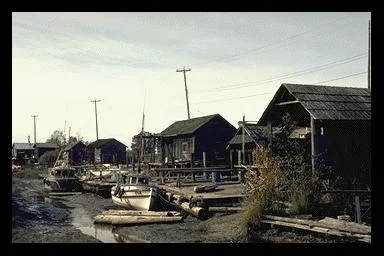
Finn Slough can look as though somebody has carefully arranged a different century beside Richmond’s road network. Wooden buildings sit at the water’s edge. Boats and boardwalks suggest a working past. A visitor with a camera may feel they have discovered a film set. The first thing to understand is that the people who live there have not been hired as extras.
This is a living community, not an abandoned village. That distinction is more than a matter of etiquette. It explains why the place has survived in such an unusual form and why the familiar visitor question, “Can I explore it?”, needs a more thoughtful answer than a pin on a map.
Source: Finn Slough: community history
Source: Richmond: Heritage Inventory, Finn Slough history
A settlement shaped by work and water
Richmond’s heritage inventory traces the community to Finnish arrivals in the 1890s. Fishing, scowhouses, cultivated land and a shared language helped people build a life at the river’s edge. The inventory describes movement to the present slough area in connection with erosion, local taxation disputes, and dyke and road construction. This was a community adapting to pressures, rather than a picturesque village designed from a tidy plan.
The residents’ own history gives the practical texture behind those dates. New arrivals did not all have the savings needed to buy large parcels of land. Some built float houses or lived aboard boats; others used net sheds. The buildings were tied to earning a living on the water. Their irregularity is part of that story, not an architectural mistake waiting to be corrected.
Source: Richmond: Heritage Inventory, Finn Slough history
Source: Finn Slough: community history
A working settlement, not a village designed for a camera
The buildings make more sense when read as working spaces. Float houses, net sheds and boats were practical responses to the need to live close to fishing grounds without the money or access required for a conventional parcel of land. Their relationship to the water came before the visitor’s search for a picturesque composition.
The community history describes how changes around Woodward Slough in 1900 affected access and helped push fishing activity towards what became Finn Slough. This is an important reversal of the usual visitor impression: the unusual settlement was not created by people choosing to step outside history. It was shaped by infrastructure and land-use decisions around them.
Today, a walk along public space can reveal that connection without entering the residential walkways. Local walkers have also noted unlit stretches in the area. Daylight is the more useful setting for a November visit, both for seeing the landscape and for returning along a route whose surfaces and edges are easier to judge.
Source: Finn Slough: community history
Source: Richmond: Heritage Inventory, Finn Slough history
Source: Richmond walking routes and unlit stretches, September 2026
Fishing, family networks and a changing Fraser River
The residents’ historical account links the early community to migration from Finland, shared work and relatives arriving after one another. Fishing initially meant demanding hand labour, with boats rowed to the grounds and nets hauled without the later machinery. The waterfront’s quiet appearance today should not make that labour disappear from the story.
Gas engines and powered net equipment changed the work over the following decades. The account also describes a strong fishing-union presence in the 1930s and a community that increasingly included people from outside the original Finnish families. A living village is more complicated than an unchanging ethnic tableau.
Those details explain the value of preserving a working landscape alongside individual buildings. The net sheds, moorings and water connections tell a story together. Respecting the community means recognising that history while leaving room for present-day residents to use their homes without being treated as part of a display.
Source: Finn Slough: community history
Source: Richmond: Heritage Inventory, Finn Slough history
Heritage does not cancel privacy
The city inventory records a complicated history of ownership and tenure. Those details help explain the community’s unusual position, but they do not turn private homes into public property. Nor should an old preservation dispute be presented as a fresh eviction threat without current evidence. Finn Slough’s long story deserves better than a dramatic caption assembled from an undated webpage.
A respectful visit keeps to public space and current signs. Do not step onto someone’s deck or cross a residential walkway because it would improve the photograph. If access is restricted, look from the public roadside and continue your walk. The point of understanding a living heritage landscape is to recognise the life in it, including someone wanting an ordinary quiet afternoon.
Source: Richmond: Heritage Inventory, Finn Slough history
Source: Finn Slough: community history
Let the place be more than a backdrop
There is no need to arrive with an elaborate checklist. Read a little of the community history before going, take in the water and buildings from places where visitors are welcome, and leave time to notice the working landscape around them. Wet surfaces, road traffic and the short autumn day are more useful planning considerations than hunting for a secret entrance.
Finn Slough is interesting precisely because it has not become a seamless visitor product. Its history contains work, displacement, improvisation and persistence. The houses are not quaint because life was effortless; they are remarkable because people made a life there at all. A photograph may bring you to the edge of the slough. The story is what stops it being merely scenery.
Source: Finn Slough: community history
Source: Richmond: Heritage Inventory, Finn Slough history
Places in this story
Finn Slough
Dyke Road at No. 4 Road, Richmond, BC
A living waterside community with Finnish fishing roots and historic wooden buildings.
Source: Finn Slough: community history
More place details
Source: Compare these places in Resources
Source: Richmond walking routes and unlit stretches, September 2026
Questions people ask
Where is Finn Slough?
The community is near the south end of No. 4 Road at Dyke Road in Richmond, British Columbia.
Source: Richmond: Heritage Inventory, Finn Slough history
Is Finn Slough abandoned?
No. It is a living waterside community. Do not treat homes or residential walkways as abandoned property.
Source: Finn Slough: community history
Why is it called Finn Slough?
The name reflects its Finnish community history. Richmond’s heritage inventory traces Finnish settlement in the area to the 1890s.
Source: Richmond: Heritage Inventory, Finn Slough history
Was Finn Slough built as a tourist village?
No. Its development was connected with fishing, housing and practical adaptations beside the river.
Source: Finn Slough: community history
Can I go onto the decks and boardwalks?
Do not assume residential structures are public. Follow current signs and stay on public space unless you have clear permission.
Source: Finn Slough: community history
Is daytime better for a first visit?
Daylight makes the buildings and route easier to see. Local walkers have described unlit stretches nearby after dark.
Source: Richmond walking routes and unlit stretches, September 2026
Is Finn Slough the same as Steveston Village?
No. It is a separate waterside community farther along the south Richmond river edge. Use its own location when planning.
Source: Richmond: Heritage Inventory, Finn Slough history
Did all residents arrive with enough money to buy land?
The community history describes differing circumstances, including people who lived in float houses, boats or net sheds.
Source: Finn Slough: community history
Why did fishing families need float houses and net sheds?
The community history describes the need to live and work near boats when newcomers could not all purchase large land parcels. The buildings form part of the fishing landscape, rather than a planned visitor attraction.
Source: Finn Slough: community history
What should photographers keep in mind?
A good view does not remove residents’ privacy. Photograph from public areas, respect signs and avoid intrusive images of people in their homes.
Source: Finn Slough: community history
Something changed? Tell us about a correction.